The possibly legendary author of the Tao Te Ching, the most famous and
influential of Taoist scriptures. Literally, Lao Tzu is a descriptive
title meaning "Old Master." According to the traditional
account, he lived in the sixth century B.C. His name was Li Erh and he
served as Keeper of the Royal Archives until retiring from civil service.
He is said to have traveled to a Western pass, where he was going to leave
the country for good, but a frontier guardsman persuaded him to give his
teachings before leaving. These teachings were written down and became the
Tao Te Ching. Postumously he was given the name Li Tan (where Tan
means long-eared, or wise). Sometimes he is also called Lao Tan, possibly
through being confused with another royal librarian of that name who lived
two centuries later.
In 142 A.D., a teacher named Chan Tao-Ling founded formal religious
Taosim based on a vision he had of Lao Tzu. In religious Taoism, Lao Tzu
was titled as T'ai Shang Lao-Chun (the Great Lord on High). He came to be
regarded as the embodiment of the Tao. Kristofer Schipper writes:
"the cosmic body of the Old Master is the image and the model of the
entire universe." Schipper quotes a text from the second century
A.D.:
Alone, without companion, he wanders in the times of yore, before there
were Heaven and Earth. He comes out of his hidden state and returns there
to dwell. Having vanished, he is the Primordial; becoming manifest, he
becomes human. Elusive! Through the transformation of Heaven and Earth and
of his spirit, he is made flesh in the bosom of Mother Li.
Sources
Kristofer Schipper,The Taoist Body.Berkley: University of California Press, 1993.

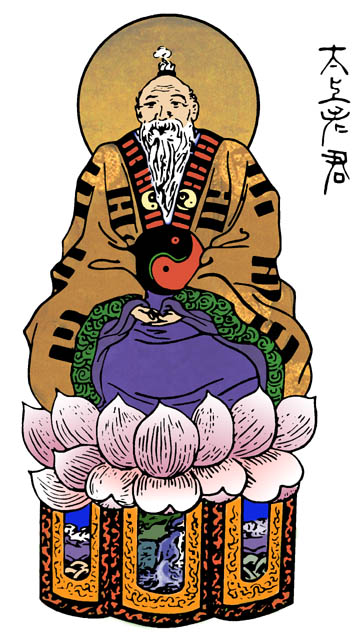
 (Colors added.)

 Berkley: University of California Press, 1993.
 . San Francisco: Mercury House,
1996.
. San Francisco: Mercury House,
1996.